
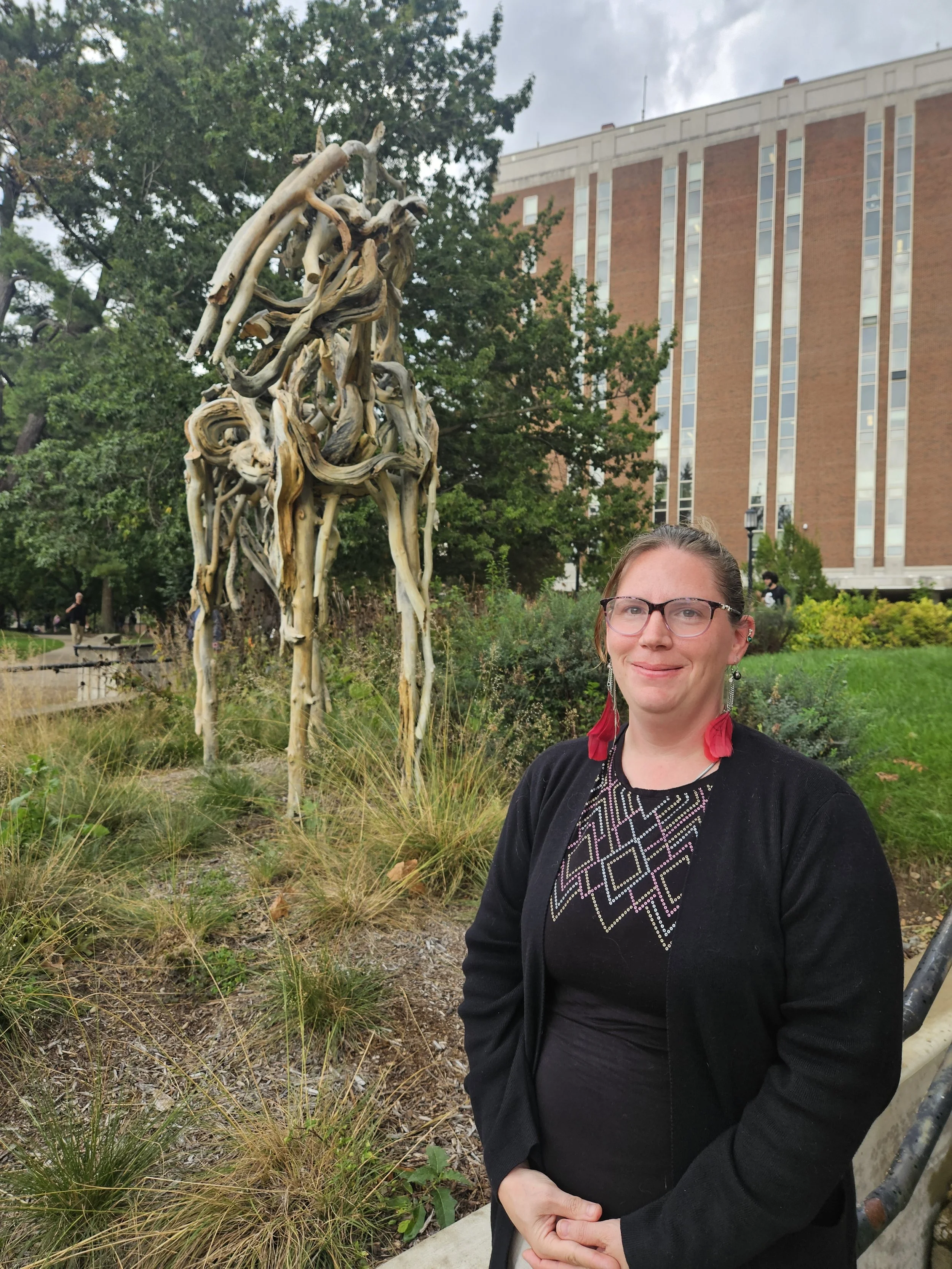
Samantha Walker is a PhD student and Academic Program Manager in the Department of Philosophy at Purdue University who works on issues at the intersections of games, education, and social cognition including agency, attention, imagination, memory, motivation, and norms. She is also an avid gamer.
A post by Samantha Walker
Kiki starts her day by preparing her daughter’s lunch and includes an orange and an avocado; she mustn’t rely on prepackaged foods. Getting dressed, she picks a top with a high neckline appropriate for work and doesn't wear black shoes with her brown pants. She doesn't ask the barista how they are doing since the line is long today, and she waits patiently for a red light at an empty intersection. She does most of these things without even thinking about them. Kiki, just like you and me, goes through her days following an array of social norms that govern her in her roles as a mother, a wife, an employee, and a member of her community. Social norms often constrain us in ways that impact aspects of our identities, gender role expectations, economic and educational opportunities, and more, with little to no intentional exploration or evaluation of these norms.
But every Friday night, Kiki mixes things up – she pretends to be someone else:
“I think we should just sneak up on the minotaur and gain the bonus for the surprise attack,” Kiki explains as Dunkin, an excited and mildly frustrated axe-wielding dwarf.
Sophie, speaking as Rose, a rogue who is as skilled with her tongue as she is with pickpocketing, disagrees. “But we gain more from the minotaur by bartering for safe passage. They are incredibly strong, but also very intelligent, and I think we could use our persuasion and wisdom stats to avoid a fight.”
Then comes a brief interruption: “I’m hungry! Mom, can you help me get a snack?”
“Sure sweetie. Ok everyone, give me a minute. I’ll be right back.” Kiki leaves the table and heads into the kitchen. She returns a few minutes later with a snack plate for herself and her guests.
Jiro, the unofficial team leader, jumps in, “Ok, everyone has had a chance to explain what they want the team to do to handle this minotaur. San wants to avoid interacting with it altogether and just take the long path through the forest. Kiki wants to try a sneak attack. Sophie thinks we can talk our way through it and maybe barter for goods or information. I think we can try an enchantment spell to distract it and sneak past, still using the most direct path through the forest. Everyone role your D20 – highest role will determine what we do.”
Kiki and her group of friends are playing Dungeons and Dragons. As in other tabletop role-playing games (TTRPG), players take on the personalities and traits of characters they have created. They roleplay as those characters, pretending to be that person for the duration of the session, and returning to the character each time they play the game. Most often, they work cooperatively in a group to play through a storyline that is set and administered by their “dungeon” or “game” master. Just like any other game, there are established rules for how the game is played. However, unlike many other games, TTRPGs require players to actively and continuously imagine what it would be like to be these characters acting in this foreign world, so that they can make decisions about what to do and thus determine how their game progresses.
Philosophers have recently been examining different dimensions of these gaming experiences, including the benefits of temporarily adopting alternative agencies (Nguyen, 2020) and the way they impact our understanding of role dynamics (Eickers, 2024; Witt, 2023). What I am interested in are the ways that social norms operate within and alongside these imaginative TTRPG sessions. The game acts as a sandbox for imaginative exploration of many kinds, including in the social domain. Specifically, this process of playing pretend within the designated game space makes possible meta-normative discourse that is not easily attainable in other environments. This provides a venue for collaborative creation, exploration, and evaluation of social norms.
This also creates an interesting inversion of the power dynamics that govern how norms are currently understood to be created and enforced in the real world. Usually, social norm creation is thought of as a process that happens implicitly through unconscious coordination between individuals and groups of people, or as something that institutions impose upon us in a top-down manner (Bicchieri, 2017). It’s less common to think of norm creation as an intentional, collaborative process through which groups of individuals collectively explore and evaluate the rules governing their ongoing interactions.
But this is exactly what happens in TTRPGs. Why didn’t Kiki just roll to sneak up and attack the minotaur? Because the group had decided on a procedure at the start of the adventure that applied to just these types of situations. When they disagreed about what to do, they would allow each team member to make a case for what the group should do, and then each person would role their 20-sided dice and the group would act on the suggestion of whoever had the highest dice role. In short, they created their own norm for how their group would settle dilemmas.
Their early adventure discussion is an example of the kind of meta-normative discourse that TTRPGs provide a space for and invite players to engage in. The group was able to openly discuss the need for a process to reduce conflict and encourage coordination within the group, with the goal of creating a more enjoyable gaming experience as well as improving their odds of successfully completing the campaign. In doing so, they have each willingly adopted the agreed upon norm; and if they violate the norm, they should expect and understand the others in their group to enforce it and sanction them. The group is also able to evaluate the norm as they go, checking in to see if it is working to achieve their goals, or if it may need to be adjusted or thrown out and replaced with a new norm all together. They may even adopt the norm that they have created within the gaming context to settle where they will order dinner from when they can't agree.
This use of meta-normative discourse extends beyond the game structure as well. Consider that the group allowed an interruption from Kiki’s child, and a break to get snacks during their session. One moment Kiki was Dunkin the Dwarf, in another she was a mom. In contrast to her day-to-day life, when she is constrained and weighed down by a multitude of norms, here Kiki is able to nimbly skip back and forth between normative environments. This is precisely because there are agreed upon meta-norms governing when players are bound by the conventions of the campaign and when these are superseded by their other roles and commitments. Getting up to get your kid a snack is fine; playing Candy Crush during the session is not.
Occasionally, one of these internal, group-generated norms will be so effective that it escapes the individual game in which it originated and spreads throughout the larger gaming community. For example, there are new norms being implemented known as 'player safety tools.' One case of these tools are 'traffic light' cards that can be used during gaming sessions, especially when new players are learning the game, or when a group of strangers may play a single session campaign together. Each player is given a set of green, yellow, and red cards, and these colors generally hold the same meaning as a traffic light. If something is occurring in the game play that is pushing the line between funny teasing and budding harassment, players are able to tap their cards to indicate if they are ok with the behavior and having fun (green), if they are beginning to get upset and want to issue a warning (yellow), or if they are no longer willing to tolerate it and would like to stop the game play altogether to discuss (red). The red option provides exactly the opportunities for the kind of meta-normative discourse discussed above, in which players can collectively determine how to best move forward in the face of conflict.
Being able to have these kinds of open and intentional conversations about the norms we are operating under – for changing those norms, and for imagining and implementing new ones – is an opportunity we have too infrequently in our daily lives. Those who do get to dictate and enforce norms are often a select set of individuals that are in positions of power (politicians, CEOs, law enforcement officials). This aspect of gameplay, on the other hand, is an illuminating inversion of control over norms, one that democratizes the community of contributors to norm exploration, evaluation, and creation.
There is much to learn from this example. While these meta-normative practices originate in TTRPGs, there is nothing stopping us from implementing them elsewhere. In many of our day-to-day activities, we could use a greater degree of flexible control over the norms that govern our social interactions. Maybe the trick is to start thinking more like a mildly frustrated axe-wielding dwarf.
* * *
Acknowledgements:
A big thank you to Dan Kelly and Evan Westra for their time spent making suggestions, edits, and their general support of the project.
References:
Bicchieri, C. (2017). Norms in the wild: How to diagnose, measure, and change social norms. Oxford University Press.
Eickers, G. (2024). Scripts and Social Cognition. Ergo an Open Access Journal of Philosophy, 10(0). https://doi.org/10.3998/ergo.5191
Nguyen, C. T. (2020). Games: Agency as Art. Oxford University Press.
Witt, C. (2023). Social Role Normativity: Internalism and Externalism. In C. Witt, Social Goodness (1st ed., pp. 19–39). Oxford University PressNew York. https://doi.org/10.1093/oso/9780197574799.003.0002