
Luke Roelofs works at the University of Texas at Arlington, digging into minds and how they fit together. Empathic Reason is their second book, linking philosophy of mind with ethics. It's due for print publication in July 2026.
A post by Luke Roelofs
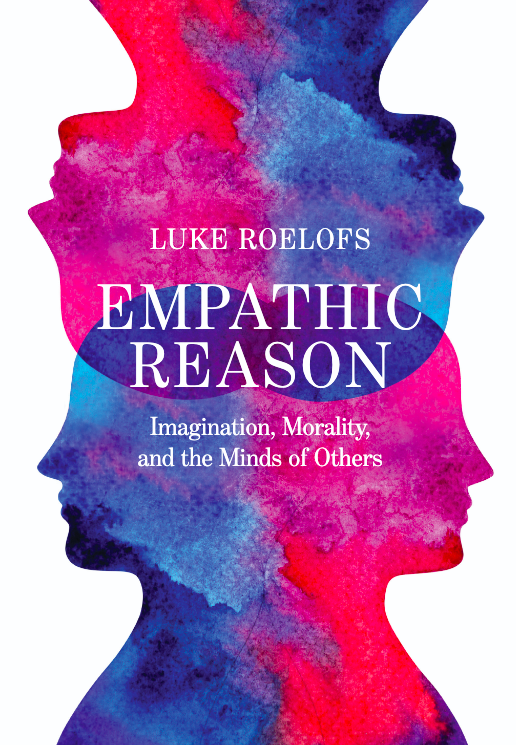
What if the philosophy of imagination held the key to moral objectivity? That idea was what drew me into the sub-field in the first place, and now I’ve gone and published a book making the case at some length. The book is called Empathic Reason: Imagination, Morality, and the Minds of Others, and Amy and Eric have very kindly allowed me to take up a spot in The Junkyard to lay out its core idea: a metaethical theory I’ve taken to calling ‘empathic rationalism.’
The starting point of empathic rationalism is the fairly familiar idea of a connection between altruism and something called “empathy”. Seeing things from someone else’s perspective by imagining ourselves in their situation seems to be connected to wanting to improve that situation. This sort of link between imagination and morality has been discussed by many philosophers, most famously Smith (1759/1976) and Hume (1751/1975) under the heading of “sympathy”. And I think it has an undeniable appeal as a basis for morality, because it seems to get the focus in the right place: other people. I should treat others fairly and kindly, not because of a divine command or a mysterious non-natural fact or the formal requirements of logical consistency, but because of something about them. The way we represent others – as the centers of their own worlds, and not just objects within ours – has always struck me as the right place to look for understanding our obligations to them.
The problem is, this sort of foundation looks like it’s ultimately subjective. We humans happen to empathize with each other quite a lot, and some of us do so more than others, so if we think of morality as something like the demands of systematic empathy, it’s going to be something with a strong hold over some people, a weaker hold over others, and potentially no hold over beings without our particular emotional proclivities. And if we find a clash between our disposition to empathize and the selfish things we would like to do, we might be able to resolve that equally well by acting better, or by quashing our empathy.
I’d like something more objective: moral obligations that hold for all rational beings, regardless of species and temperament. That attracts me to moral rationalism, which historically has often been seen as opposed to empathy-based morality. Here’s where I draw on a second strand of philosophy of imagination: the recent emerging discussion of imagination as an epistemic tool (see, e.g., Dorsch 2016, Kind 2016, 2018, Myers 2021, 2024).
The idea here is that when our imaginings are constrained and targeted in the right way, they can teach us things - that is, they can provide good justifying reasons for both beliefs and (more controversially) for actions. Imagining the path of a projectile might justify expectations about its likely trajectory; imagining how I’ll feel tomorrow morning if I go out tonight might justify not going out. Imagining a situation from someone else’s point of view might justify expectations about what they’re likely to do and, crucially, I think that it can also directly justify acting to help them get what they want and feel better. Empathy is an epistemic use of imagination, or what I like to call an imaginative simulation.
The justifications provided by imaginative simulations are, admittedly, often a little shaky. They draw on pre-existing background knowledge, depend on our own cognitive agency to keep the model faithful to its target, and are prone to a variety of common biases and pitfalls. If we could directly perceive the thoughts and feelings in another’s head, then we’d often be better off doing that. But the interesting thing about other minds, I argue, is that they can only be fully represented through imaginative simulation. This makes empathy (in the sense of “imaginative simulation of other minds”) epistemically indispensable even when it’s uncertain and arduous.
There is an obvious objection you may have already been thinking of, which in my book I call the Obvious Objection. It goes like this: “empathy may be one form of imaginative simulation of other minds, but it can’t be the only one. It seems perfectly possible - even common - to simulate other people’s minds unempathically, perhaps to better manipulate or torment them. Or, if we insist on calling this sort of thing ‘empathy’, then there doesn’t seem to be any essential link between empathy and altruism.”
(This is a version of a broader objection to moral rationalism: it seems possible for someone to be both perfectly rational and happily immoral.)
Here’s where I draw on a third theme from the philosophy of imagination: the role of imagination in what could broadly be called “pretense”. I think that the very same imaginative capacities are used both to simulate aspects of reality, and to engage with fictions and fantasies. Indeed, we might imagine the very same things, one day as a simulation, one day as a mere pretense. The key difference is that in the one case, because we’re trying to model something in reality, we can end up with genuine reasons for belief and action; in the other case, because we are not committing ourselves to anything about reality, we don’t. But the two modes of imagining are similar enough that we might come to mistake one for the other. Sometimes we get so caught up in a fictional world that we start experiencing it as real. And sometimes with other minds, I think, we do the opposite: we lose sight of the fact that what we’re imagining is someone’s real perspective, and start treating it like a useful and engaging fiction.
I think a hypothetical, perfectly consistent, egoist is exploiting this flexibility of the imagination to systematically treat their imaginings of other minds as pretenses rather than simulations, and thus as not imposing rational constraints on how they act. They relate to other people, so to speak, as NPCs, props or background characters in the story of their lives. They may do this subconsciously, and I think it’s an open question how best to describe this sort of rational failing. But the most provocative description (which I therefore favor) is that they don’t really believe in other minds, even if they think they do. They’re solipsists in denial.
This “Solipsistic Diagnosis” may not apply to any real individuals - it may be that no real individual is a perfectly consistent rational egoist. Maybe even the worst humans are better understood as inconsistent, hypocritical, or fanatical. But it’s still dialectically important to be have a diagnosis of what a hypothetical idealised egoist would be getting wrong. Moreover, empathic rationalism suggests a sort of warning, that partial, selective solipsism is a more nearby risk than we might think.
In discussions of the epistemic role of imagination, there’s sometimes resistance to letting imagination be a source of justification, because of its association with fantasy and daydreaming and other forms of thought that are untethered to reality. And there’s something to that: given that we can imagine in those unconstrained ways, it’s important to be able to imagine things without letting them update our beliefs or dictate our actions. The problem is that we also need imagination to understand other minds, and that when we use it in this constrained, reality-oriented way, we are rationally required to let it update our beliefs and dictate our actions. And so as a result there’s a standing risk and temptation to lapse into treating inconvenient reality-oriented imaginings the way we treat fantasy and daydreams.
References
Dorsch, F. 2016. “Knowledge by Imagination: How Imaginative Experience Can Ground Factual Knowledge.” Teorema 35(3), 87–116.
Hume, D 1751/1975. Humeʼs Enquiries Concerning the Principles of Morals, ed., L. A. Selby-Bigge and P. H. Nidditch. Oxford University Press.
Kind, A. 2016a. “Imagining under Constraints.” In A. Kind and P. Kung (Eds.), Knowledge Through Imagination (pp. 145–159). Oxford University Press.
Kind, A. 2018. “How Imagination Gives Rise to Knowledge.” In F Dorsch and F Macpherson (Eds.), Perceptual Memory and Perceptual Imagination (pp. 227–246). Oxford University Press.
Myers, J. 2021. “Reasoning with Imagination.” In C Badura and A Kind (Eds.), Epistemic Uses of Imagination. Routledge.
Myers, J. 2024. “Imagination as a Source of Empirical Justification.” Philosophy Compass 19(3), e12969.
Smith, A. 1759/1976. The Theory of Moral Sentiments, D D Raphael and A L Macfie (Eds.). Oxford University Press.